Key takeaway: A genuine one ounce Krugerrand weighs 33.93 g, measures 32.77 mm across and 2.84 mm thick, has a reeded edge, does not stick to a magnet, and shows a sharp Paul Kruger portrait on one side and a springbok on the other. Bullion Krugerrands carry no serial number, so do not expect to find one. Home checks catch crude fakes, but only a professional test such as XRF analysis proves the gold content, and The Gold Avenue in Illovo, Sandton runs that test in front of you, free of charge, before making an offer.
A genuine one ounce coin contains a full troy ounce of fine gold and its value tracks that gold. A convincing fake is worth close to nothing. Here are the checks you can do at home, the tells that separate a fake from a real coin, the honest answer on serial numbers, and the test that settles it without harming the coin.
What is a Krugerrand?
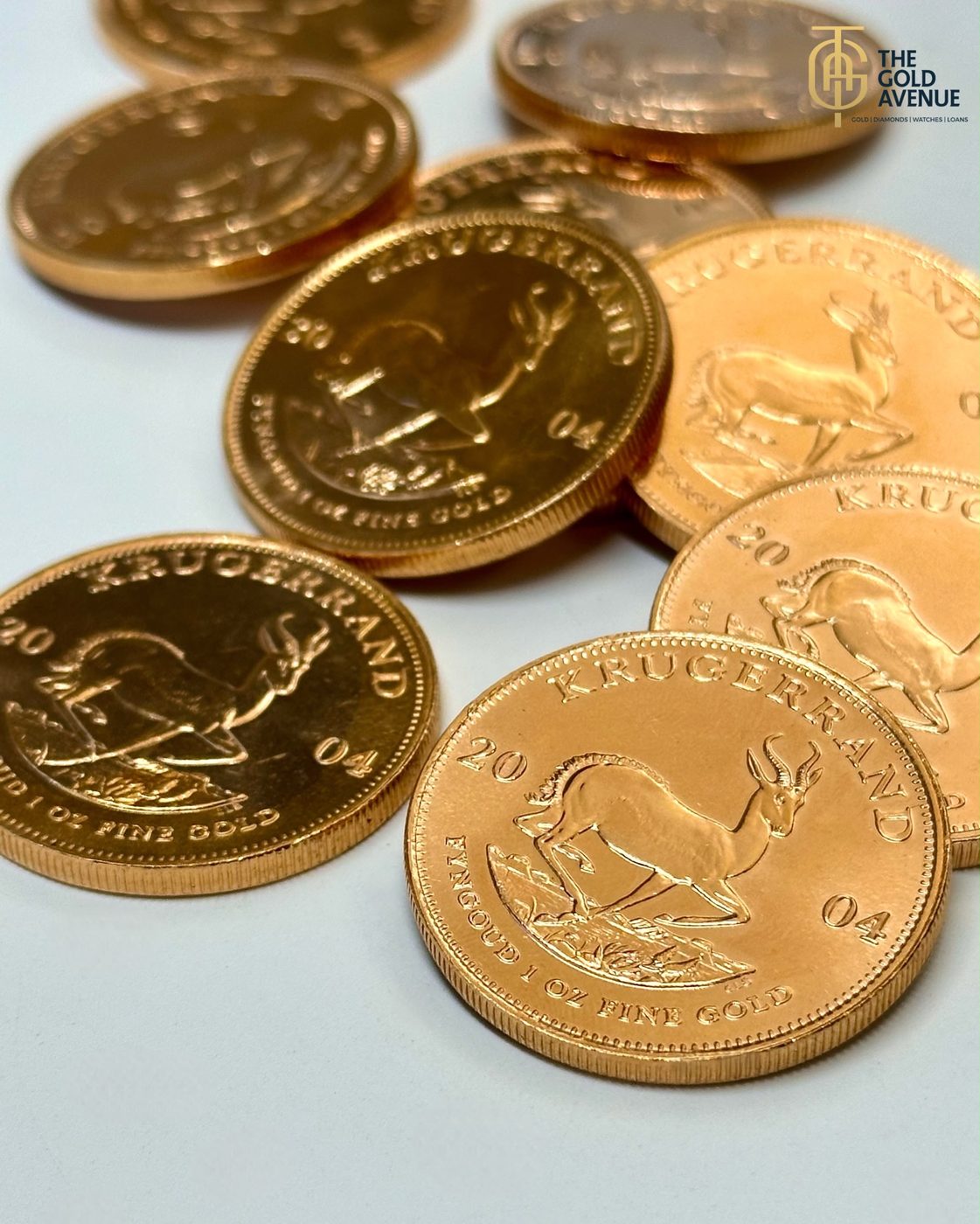
The Krugerrand is South Africa’s gold bullion coin. It was first minted in 1967 by the South African Mint, using gold refined by Rand Refinery, and it was built for one job: to put a known quantity of gold into a coin that anyone could own and trade. The obverse carries a portrait of Paul Kruger. The reverse carries a springbok designed by Coert Steynberg.
It is legal tender in South Africa but carries no face value. Its worth is its gold content priced against the live market, which is why buyers weigh and test it rather than reading a number off the coin. Half, quarter and tenth ounce sizes followed in 1980. For the full story, read the history of the Krugerrand.
What does a real Krugerrand look like?
Start with your eyes. Fakes are caught on detail.
- Obverse: the head of Paul Kruger, with clear facial detail and crisp, evenly spaced lettering around the rim.
- Reverse: the springbok, mid stride, with clean definition in the horns, legs and body, plus the fine gold weight and the year of issue.
- Edge: reeded, meaning fine, even, parallel grooves all the way round. A smooth edge, uneven grooves or a visible seam is a warning sign.
- Colour: a warm, slightly orange tone. The Krugerrand is 22 carat, 91.67% gold alloyed with copper for durability, and the copper gives it that tint. A coin that looks bright lemon yellow like a 24 carat piece, or pale and brassy, deserves a closer look.
- Strike: confident and clean. Soft lettering, mushy detail or a blurred springbok point to a cast copy rather than a struck coin.
Honest wear softens detail but keeps it accurate. A fake is not worn, it is wrong: letters the wrong shape, a springbok that looks slightly off, a portrait with the wrong proportions.
Krugerrand weight and size: the numbers a one ounce coin must match
The Krugerrand has fixed, published specifications. A fake almost always misses on at least one, because getting weight, diameter and thickness right at the same time requires the right metal.
| Specification | Genuine one ounce Krugerrand |
|---|---|
| Fine gold content | One troy ounce (31.1035 g) |
| Total weight | 33.93 g |
| Purity | 22 carat (91.67% gold, balance copper) |
| Diameter | 32.77 mm |
| Thickness | 2.84 mm |
| Edge | Reeded (serrated), 160 serrations on bullion, 220 on proof |
| Magnetic | No |
| Serial number | None on bullion coins |
The coin holds a full troy ounce of gold, then adds copper for strength, which is why the total comes to 33.93 g rather than 31.1035 g. A one ounce Krugerrand that weighs noticeably less, or more, is a problem.
Weigh on a scale that reads to a hundredth of a gram. Half, quarter and tenth ounce coins are smaller and lighter; we test them the same way.
Will a real Krugerrand stick to a magnet?
No. Gold is not magnetic and neither is copper, so a genuine Krugerrand will not be attracted to a magnet at all. Hold a strong magnet close to the coin. If the coin pulls, tilts or clings, it contains iron or steel and it is not a Krugerrand.
Passing the magnet test proves less than people think. Plenty of base metals are non magnetic, so a plated fake with a lead or brass core sails through. The magnet rules out the crudest copies. It does not rule a coin in.
The ping test
Balance the coin on a fingertip and tap it lightly with another coin. A genuine Krugerrand gives a clear, sustained ring. Plated base metal sounds short and dull. It is subjective, and it will not catch a well made fake with a heavy core, so use it as one more filter, not as proof.
Do Krugerrands have serial numbers?
Bullion Krugerrands do not have serial numbers. There is no number stamped on the coin, none on the edge and no register to look one up in. The absence of one is normal.
What a bullion Krugerrand does carry is its year of issue and its fine gold weight, both on the reverse. Proof Krugerrands are sold in presentation packaging with a certificate, but that is not a serial number on the coin itself. Authentication comes down to what the coin is made of, which is why weight, dimensions and a metal test matter more than any paperwork.
Fake Krugerrand vs real: the tells to look for
Fakes tend to fall into three groups.
- Cast copies in base metal, gold plated. Light on the scale, often the wrong colour, soft on detail, sometimes magnetic. The plating wears at the high points and shows grey metal underneath.
- Correct weight fakes with a heavy core. A dense base-metal core under a thick gold layer can hit the right weight and near enough the right size. These need a proper metal test. Sometimes the diameter or thickness is slightly out to compensate.
- Low purity gold. The coin is gold, just not 22 carat. It may look right and weigh close to right, and only a purity test exposes it.
Quick tells: wrong weight, a seam on the edge, uneven reeding, uneven lettering, a cartoonish springbok, a colour that is too yellow or too pale, and any attraction to a magnet. One of these is enough to pause. Two or more and the coin is almost certainly not genuine.
Why home checks are not proof on their own
Weight, size, design, colour, magnet and sound together build a strong case. Even combined, they can be beaten by a good counterfeit. A heavy core can match the weight. Plating hides what is underneath. Kitchen scales drift. This is why a serious buyer never relies on appearance. Use the home checks to spot obvious problems, then have the coin tested professionally before you sell. Testing is free at The Gold Avenue, so there is no reason to guess.
How a dealer tests a Krugerrand without damaging it
The professional method is X-ray fluorescence, or XRF. The Gold Avenue uses Niton XRF gold analysers. The analyser reads the elemental make up of the metal from the surface and reports the gold percentage directly. For a genuine Krugerrand the reading comes back at 22 carat, with copper as the balance. A plated coin, a low purity coin or a base metal coin reads wrong immediately. The test takes seconds, leaves no mark, and is done on the desk in front of you in a private consultation booth.
Alongside the XRF reading, the coin is weighed and measured against the specifications above, and the design and edge are inspected. When the numbers and the metal both match, the coin is real, and only then is it priced on the live gold price plus that day’s local trade prices, the method explained on the Krugerrands page.
Never file, drill or acid test a Krugerrand
Do not scratch a Krugerrand to see the gold underneath, do not file the edge, and do not put acid on it as you might on scrap jewellery. Each of these permanently damages the coin and can knock value off a piece that was genuine all along. XRF answers the question without touching the surface. Keep the coin as it is and let the test do the work.
If you are also checking jewellery, our guide on how to check if gold is real covers hallmarks and the other tests. When you are ready to sell, how to sell Krugerrands in South Africa covers the documents and the process.
Frequently asked questions
How can you tell if a Krugerrand is real?
Check the coin against the specifications in the table above, then get it XRF tested.
Do Krugerrands have serial numbers?
No. Bullion Krugerrands have never carried serial numbers. They show the year of issue and the fine gold weight, nothing more. Authentication depends on the metal and the specifications, not a number.
What does a fake Krugerrand look like?
Typically slightly wrong in colour, light on the scale, soft in detail, uneven on the edge, and sometimes magnetic. Better fakes can match the weight and are only exposed by a metal test such as XRF.
Will a real Krugerrand stick to a magnet?
No. Gold and copper are both non magnetic. Any pull towards a magnet means the coin contains iron or steel and is not genuine. A coin that ignores the magnet still needs further checks.
Does a scratched or worn Krugerrand lose value?
For a bullion coin, wear makes little difference because it is bought on its gold. Proof coins are assessed separately, so keep those in their packaging and do not clean them.
Get your Krugerrand verified and valued in Illovo, Sandton
Bring your coin to The Gold Avenue and a Purchasing Consultant will weigh it, measure it and run the Niton XRF test in front of you in a private, air conditioned booth. If it is genuine, you get a no obligation offer priced on the live gold price plus that day’s local trade prices. If you accept, your details are captured on an iPad, you sign a one page Sale Agreement, and payment is by immediate EFT or cash. The whole visit typically takes 10 to 15 minutes. The Gold Avenue is registered with the Financial Intelligence Centre as a Krugerrand dealer and is a registered second-hand goods dealer under the Second-Hand Goods Act, so bring your ID and proof of banking details.
Find us at Office 804, 8th floor, Illovo Point, 68 Melville Road, Illovo, Sandton, 2196. Open Monday to Thursday 08:00 to 17:00, Friday 08:00 to 16:00, Saturday by pre-booked appointment only, closed Sunday and public holidays. Walk in, or book ahead and we will send you step by step directions with photos of the entrance, parking and lift.
Call 010 109 0080, WhatsApp 076 393 5429, or book a free valuation at https://thegoldavenue.co.za/request-a-quote/.
Written by Trent Saldsman, Founder and Managing Director, The Gold Avenue.

Trent Saldsman is the Founder and Managing Director of The Gold Avenue, the gold, diamond, Krugerrand and luxury watch buyer he established at Illovo Point, Sandton in April 2022, and a Finalist in the Absa Eric Ellerine Entrepreneur Award 2024. He built The Gold Avenue as a secure, professional and transparent alternative to the traditional pawn-and-gold-buying trade, and works with an extensive local and international dealer network to pay sellers more competitively for their gold, diamonds and watches.